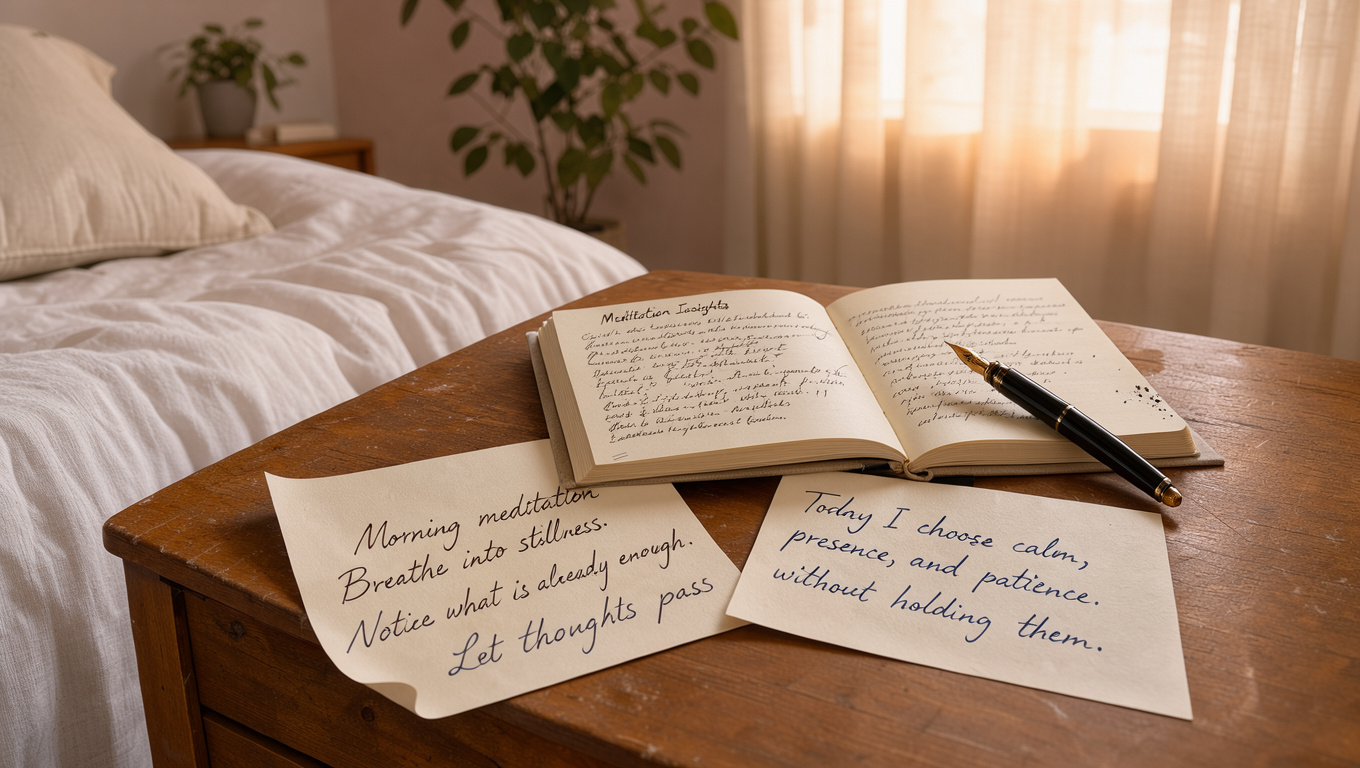
A brief morning pause followed by a few written notes can create space for reflection without requiring a vivid or complete dream memory. Meditation journaling can begin with one image, a feeling, or no recalled dream at all. Dream recall means remembering dream content after waking.
The practice can help us notice what lingers before daily plans take over. We do not need to solve a dream or turn every morning into a long session. A simple pause, followed by writing, makes room for honest reflection.
Key Takeaways
- Start with a brief pause and write what comes to mind.
- A fragment, a feeling, or no dream memory can all fit.
- Use the practice for reflection, not a perfect record.
- Let the goal be noticing what is present, not producing a particular kind of dream.
Why we may dream but remember little after waking
Remembering a dream is different from having one, and the memory can fade as soon as our attention shifts to the day. Dream recall can be brief, even when a dream felt vivid moments earlier.
Dream recall frequency does not tell us how often we dream. About 80% of people awakened during REM sleep recalled a dream. Young adults in clinical practice recalled dreams upon waking once or twice a week.

Dream recall is something to observe over time, not a measure of whether we dreamed.
A Simple System To Remember Dreams Meditations and Visions
Dream memories can fade when we turn to a phone, a conversation, or the day’s tasks. A closer look at why dream memories fade explores how waking attention can affect what we keep.
Lucid dreaming means knowing we are dreaming while the dream is happening. A 2025 systematic review of three studies and six substudies found the link between mindfulness and lucid-dream frequency inconclusive.
Mindfulness journal prompts and a reflective writing practice may support self-reflection, but they cannot promise easier recall. Treat dream recall as something to observe over time, not a measure of whether we dreamed.
Meditation Journaling: A Morning Record for Dream Details
A journal within arm’s reach makes it easier to save a detail before the morning takes over. Meditation journaling works best when a quick note feels useful, not like homework. A few words, one image, or one feeling word is a worthwhile entry.
A 2022 review reported that interest in dreams, including keeping a dream diary, increases dream recall. The record does not need a full story to help us notice what returns over time.

A Simple System To Remember Dreams Meditations and Visions
Keep a physical journal beside the bed
Keep a notebook and pen where we can reach them without searching. Choose a format with enough room for short notes, since a blank page can make a fragment feel welcome.
We can turn to The Black Journal Series for a separate read about journaling. Keep our dream record focused on what we remember, rather than trying to make each entry sound polished.
Record the dream title, date, time, setting, and mood
Five simple fields can give an entry shape without taking much time. A title can name the strongest image, while the other details help us place the memory later.
- Title
- Date
- Time
- Setting
- Mood
For example, an entry might read: “Blue Hallway,” October 12, 6:40 a.m., an empty school, uneasy. The details can stay brief, and we can leave a field blank when nothing comes to mind.
Capture single images, sensations, and feelings without judgment
A note such as “wet grass,” “heavy arms,” or “relief” can hold the part that stayed with us. We do not need to add a meaning or explain how the scene fits our life.
On busy mornings, a few words can take less time than making coffee. The entry still gives us a point to return to if more detail appears later.
Leave space for later additions when an image or feeling returns during the day.
A morning dream-recall routine before opening our eyes
Before opening our eyes or planning the day, we can give the most recent dream a quiet moment to return. Staying in the same position and recalling before thinking about daily tasks can support retrieval. Write down as much detail as possible before getting up.
If no scene appears, a feeling or body sensation can offer a starting point. The task is to notice what remains, rather than force a full story into view.

A Simple System To Remember Dreams Meditations and Visions
Stay still and review the most recent dream in reverse
Begin with the last scene or moment we remember, then work backward through what came before. This reverse review may bring back a place, action, or person that was missing at first.
Use a gentle pace. If the story stops, wait a moment and see whether another detail arrives without guessing or filling in gaps.
Use a memory palace to revisit dream scenes
A memory palace is an imagined space that helps us use places as memory cues. We can picture three rooms and move through them in order:
- Enter an entrance hall and pause for any scene that comes to mind.
- Visit a chosen dream room and notice what detail seems tied to it.
- Step into a room for last night’s dream and revisit its remembered scenes.
The rooms do not need to match a real home. A clear, familiar layout is enough to give the mind a path through loose images.
Write down every detail before getting up
Once a scene returns, record its actions, places, people, and sensory details in plain words. Include small pieces that seem odd or unimportant; we can decide later whether they matter.
If only a body sensation remains, note it before trying to name the dream. A tight jaw, warmth, or a racing heart can mark what was present without proving what caused it.
Record the last detail that comes to mind, even if the dream remains incomplete.
How guided meditation and breath awareness prepare us to reflect
A few comfortable breaths can give us a calmer starting point for morning reflection. Breath awareness helps us notice our pace without demanding a special mood. These practices can settle attention, but they do not guarantee dream recall.
We can try a short guided meditation or breathe quietly on our own. The aim is to make a little room for reflection, not to chase a dream memory.
Begin with gentle belly breathing to settle the mind
Rest a hand on the belly and notice how it rises and falls with each breath. Let the inhale and exhale stay easy, with no need to pull in more air than feels natural.
This simple start can make us aware of tension without turning the practice into a test. If our attention wanders, we can return to the movement under the hand.
Try a seven-three-seven breathing pattern with a clear intention
For an optional pattern, inhale for seven counts, hold for three, then exhale for seven. During the hold, we can set a simple intention, such as meeting the morning with curiosity.
Some people alternate nostrils during the same pattern and use the hold to focus on that intention. We should return to natural breathing if counting or holding feels uncomfortable.
Insight Timer offers a 16-minute “Dream Recall Practice” by Gale Minchew and a 12-minute “Working With Your Dreams: A Guided Practice For Dream Recall” by Pascal Raabe. These are examples of guided tracks, not endorsements.
Finish with a body scan and relaxed attention
After breathing, bring attention to the head, face, neck, shoulders, arms, chest, belly, legs, and feet. Notice each area without trying to change what we feel.
A body scan can also show where effort has crept into the practice. We can soften the jaw or lower the shoulders, then let attention rest where it feels comfortable.
Keep the breath easy enough that the practice feels settling rather than effortful.
Mindfulness journal prompts for dream fragments and emotions
A useful prompt begins with what we actually remember, such as the first image or strongest feeling. Mindfulness journal prompts can help us explore a fragment without treating any meaning as certain. A symbol does not have one fixed meaning for everyone.
A 2022 online survey included 1,537 participants with a mean age of 35.1 ± 15.8 years. Across reviewed studies, openness to experience had a small association with dream-recall frequency, not a guarantee for any individual.
Use self-reflection prompts to explore images, people, and symbols
Start with a plain account of what stood out, then note any personal connection that comes to mind. Prompts can open a thought without deciding what the dream must mean.
- What was the first image we remember?
- Which person or object stood out most?
- What feeling seemed strongest in the dream?
- How do we feel now that we are awake?
We might connect a locked door with a recent choice, or it may simply be a door from the dream. Personal associations can be useful, but a symbol should not be treated as a code with one answer.
Add mood tracking to connect dreams with waking feelings
A brief mood-tracking note can sit beside a longer reflective paragraph. We might write “calm, 3 out of 5” and then describe which part of the dream stayed with us.
Keep the rating simple enough to repeat. A short note can help us spot changes across mornings without turning each feeling into a judgment.
For a separate browse beyond dream reflection, the Amazon.com page is another place to explore reading material.
Turn dream notes into a reflective writing practice
We can write for a few sentences about the image, our personal association, and what remains uncertain. This reflective writing practice can stay open-ended, with no need for a lesson or a neat ending.
If an interpretation does not fit, return to what we can describe directly. Keep an interpretation tentative and return to the concrete image or feeling when a meaning does not fit.
Keep the practice gentle, consistent, and emotionally safe
A steady practice should leave room to pause when a dream feels too intense to explore. Emotional regulation can mean stepping back, grounding ourselves, or choosing not to revisit details. A dream is not proof of a message or a required form of connection.
Dream reflection should fit our needs on that morning. We can stop writing if a memory brings grief or distress, rather than pushing through for a complete account.
Use emotional regulation when dreams bring grief or strong feelings
Pause and notice the room around us if writing starts to feel overwhelming. We can name a few things we see, feel our feet on the floor, or turn to an ordinary task.
These small actions can help bring attention back to the present. We do not need to explain the dream or decide what it means before we move on.
Add a gratitude practice after recording difficult memories
After a difficult entry, we might name one thing that feels steady or kind in our day. A gratitude practice could be as small as noticing a warm drink, a familiar voice, or a safe place to sit.
This does not erase grief or make a hard memory pleasant. It simply gives our attention another place to rest when we are ready.
If dream reflection repeatedly intensifies distress, step back and seek support from someone we trust or a qualified professional.
Use habit tracking without pressuring ourselves to remember perfectly
Make one small mark on a calendar when we show up for the practice. The mark can count a pause, a few words, or a decision to leave the dream alone.
A 2025 daily-survey study followed 44 healthcare employees over five consecutive workdays. Morning meditation was significantly associated with increased positive affect and better end-of-day health indicators.
When the previous night’s sleep quality was poor, positive affect significantly linked morning meditation with end-of-day mental health and vitality. These associations do not prove meditation caused the outcomes, and they may not apply to everyone.
Conclusion
Dream reflection can begin with whatever is present, including a fragment or uncertainty. Small, nonjudgmental notes can make a reflective writing practice easier to keep than a demand for perfect recall.
Tomorrow, we can pause briefly and write one detail or feeling. A quiet note can be enough, and a small gratitude practice may help us end on a steady thought.
Choose one small practice to try tomorrow, then adjust it to what feels manageable.
Leave a Reply